
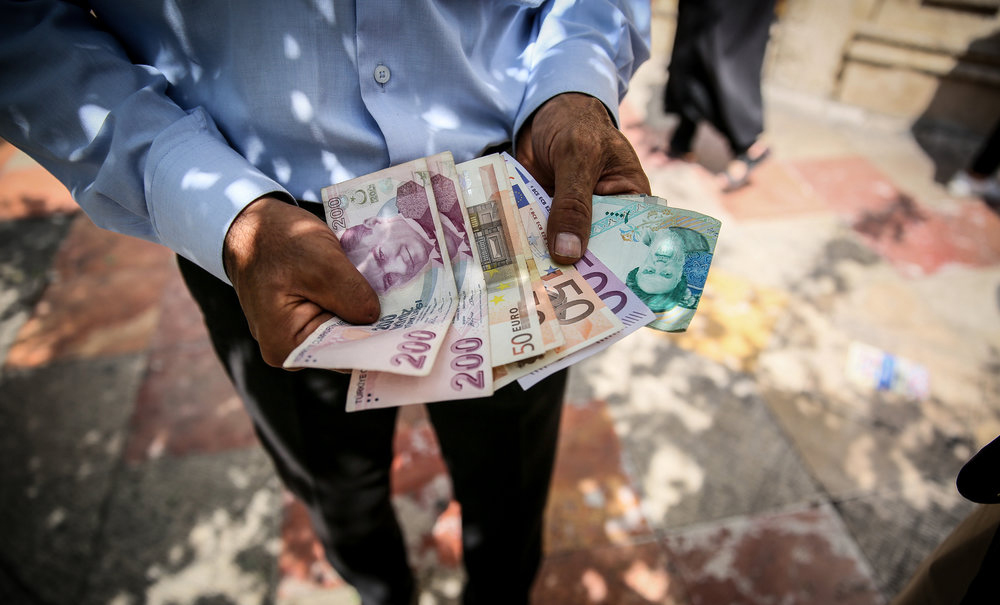
The Central Bank of Iran has issued the latest figures related to hard currency trade in the Secondary Forex Market between exporters and importers. According to the bank, between Aug. 7 (the time when CBI eased currency controls) and Sept. 11, trade volume reached €2.81 billion.
Hard currency allocated to imports during this period amounted to €2.45 billion, indicating that currency supply has so far outweighed demand.
The secondary market dealings take place through the Forex Deals Integrated System, an online system locally known by its acronym Nima. Through the system, importers declare their currency needs and exporters offer their foreign currency earnings for sale. Banks and exchange bureaus act as mediators for the dealings.
Although at first, deals only took place at the fixed rate of 42,000 rials, the government gradually eased the rules so that exporters and importers could trade at “negotiated” rates between themselves.
Central bank officials say 97% of the country’s hard currency trade take place in the secondary market and only 30% of the dealings occur in the form of physical currency trade. This market, known as “the third market”, is where exchange rates tend to be well above the Nima rate that is less swayed by the currency volatility that has rocked the market for the last couple of months.
CBI officials also insist that due to its size and importance, the secondary market is the “real” venue recognized by them.
Ahmad Mahdavi Abhari, the head of Guild Association of Petrochemicals, told the IRIB news website that petrochem companies have collectively brought in $4 billion into the country since the start of the year on March 21.
He added that from Aug. 7-Sept. 10, petrochem firms have brought in €1.76 billion into Nima, which accounts for 70% of the total amount.
At a meeting attended by CBI officials on Tuesday, Masoud Khansari, president of Tehran Chamber of Commerce, Industries, Mines and Agriculture, criticized the red tape involved in the currency trade through Nima where, he said, a 16-step process is required and if one step fails, the importer has to go all the way back to the first place. He likened the process to a game of “Snakes and Ladders.”
CBI also announced that as of Tuesday, the average exchange rate for euro in Nima was 91,460 rials.
On August 6, CBI eased foreign exchange rules and allowed moneychangers to resume work at open market rates as part of the latest rescue package intended to calm the markets.
The fresh strategy came after the government decided to unify the US dollar’s exchange rate at 42,000 rials on April 9 in response to the rial’s freefall.
At the time, it also banned the physical trade of hard currency by exchange shops and the trading of the US dollar at any rate other than the official rate.
Since then, it has also allowed exchange bureaux and exporters to import hard currency into the country and sell it at open market rates.
Currency Repatriation
Despite the easing of rules, the central bank insists that exporters should bring their hard currency earnings into the “economic cycle” of the country. Exporters say that while they do not have a problem with this, the way it is done is problematic.
An updated CBI directive was issued on Monday, ordering exporters to repatriate 95% of their hard currency three months after their customs export license has been issued. Exporters can keep the remaining 5% for such costs as marketing, advertisement and overseas office expenses.
While another expected updated version was notified on Wednesday, it left the three-month deadline unchanged. Some exporters say that with the bureaucracy involved in obtaining hard currency goods clearance, it is hard for them to meet that deadline.
President of Iran Chamber of Commerce, Industries, Mines and Agriculture wrote a letter to First Vice President Es’haq Jahangiri, in which he made eight proposals to reform the currency repatriation process.
Gholamhossein Shafei criticized the deluge of directives that have inundated business people in recent months, asking that at a time when the country’s banks cannot conduct financial transactions, how can the government expect exporters to bring their hard currency into the country?
The ICCIMA chief considered the three-month period for exporters to declare their currency as impractical and called for periods of six months, nine months and one year to supplant it.
Since exports to Iraq, Afghanistan and the Commonwealth of Independent States are done in Iranian rial, exports to these countries cannot be subject to this ruling.
Shafei noted that the 5% freight on board value of goods that can be kept by exporters for their costs is not enough and has to be increased to 10%.